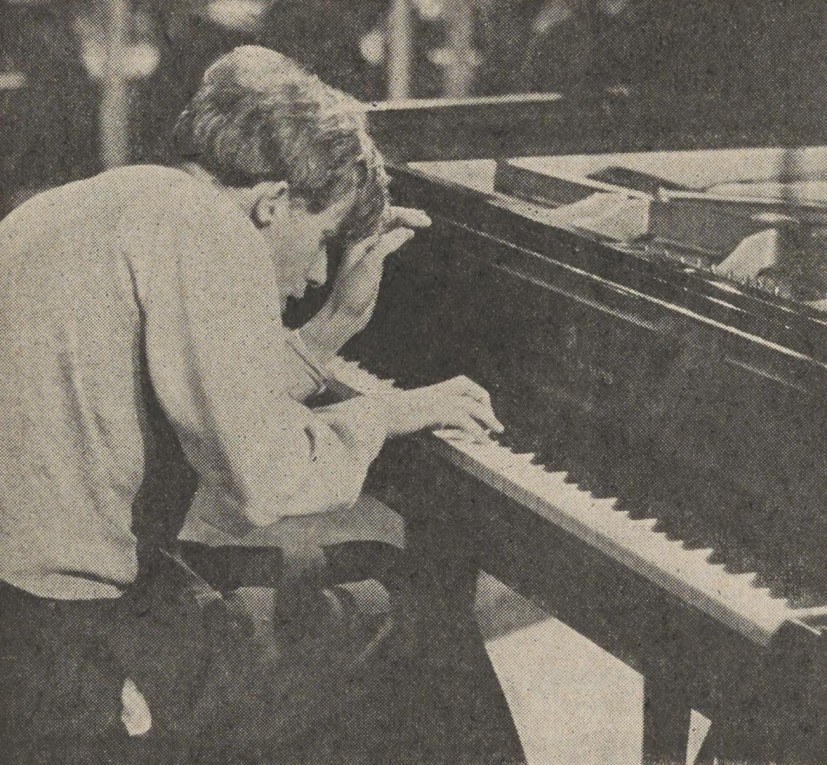
Ten days before his death, Glenn Gould sat alone in a Toronto recording studio and completed a project he had been building toward, in various ways, for twenty-seven years.
The 1981 recording of Bach's Goldberg Variations — his second, made for CBS Masterworks almost three decades after his legendary 1955 debut — was released one month before he died. Gould had been so particular about the sessions, so insistent on specific tempos and specific takes, that the recording engineers described a quality of intentionality that went beyond his already legendary perfectionism. He seemed, they said, to know exactly what he was making.
What he was making, forty-four years later, nobody fully agrees on.
The Two Recordings, and the Distance Between Them
To understand why the 1981 recording matters, you need to understand what it was responding to. The 1955 Goldberg Variations — recorded when Gould was twenty-two, released to immediate and improbable acclaim — is one of the most celebrated piano recordings in history. It is fast, brilliant, and almost aggressively youthful: a young man playing one of Bach's most architecturally complex works as though he has found a secret door inside it and is racing through.
The 1981 recording is, in almost every measurable way, its opposite. Where the 1955 version averages around 38 minutes, the 1981 takes over 51. Tempos that were quicksilver become contemplative. Ornamentation that was decorative becomes structural. The whole approach suggests a man who has lived with these thirty-two variations for a lifetime and has arrived, finally, at what he actually thinks they mean.
Gould himself was unsparing about what the 1955 recording got wrong. His verdict, offered in interviews around the time of the 1981 release, was that the earlier performance contained "too much piano playing" — a phrase he intended in the most unflattering way possible. Coming from the pianist who made that recording famous, it is a remarkable act of self-revision: a declaration that brilliance, untempered by something harder to name, was not enough. The 1981 recording is, in part, his answer to his own criticism.
This alone would make it a significant document. What makes it haunting is the timing.
The Sessions
The recording was made over several days in April and June of 1981. Gould, who had retreated almost entirely from live performance more than fifteen years earlier and spent most of his career in the studio, was fifty years old and in declining health, though the full extent of his physical deterioration was not public.
Witnesses to the sessions describe an artist who was, if anything, more demanding than his reputation. Particular takes were rejected for reasons that puzzled the engineers — not wrong, but not right in some way that Gould could apparently hear and they could not. The sessions ran long. He returned to passages he had already completed, not to fix errors but to find something he hadn't located yet.
The sessions were filmed by the French documentary maker Bruno Monsaingeon, and the footage survives as the most direct record of what the room felt like. What is immediately striking about the film is its opening: the camera does not begin on Gould or on the piano, but on the bank of analogue dials and switches inside the studio's control booth. Only then does it pan across and push in toward the pianist himself. It is a choice — whether Monsaingeon's or Gould's — that says something precise about how Gould understood the recording process: the technology was not incidental to the music but part of it, the room itself a kind of instrument. When the aria finally begins, slowed to a pace that feels almost geological, Gould is already hunched in his characteristic posture, his body swaying, looking, as one observer noted, aged considerably beyond his fifty years.
"He knew what he was looking for," one participant later recalled. "I'm not sure any of us knew what it was."
The final session ended on a Sunday afternoon. Ten days later, Gould suffered the stroke that would kill him. He never heard the completed album.
Four Theories
The musicological literature on the 1981 Goldberg Variations is substantial and inconclusive. What follows is a summary of the major interpretive frameworks that have accumulated around the recording.
The Farewell Theory holds that Gould, consciously or unconsciously, understood that his time was limited and made recording decisions accordingly — slowing tempos to extend the experience, dwelling in passages that held personal significance, creating something intended to outlast him. Proponents point to the unusual deliberateness of the pacing and the particular care given to the final variation, the quodlibet, which Gould plays with an intimacy that sounds less like performance than private contemplation.
The Correction Theory argues that the 1981 recording represents Gould's definitive statement on what the 1955 recording got wrong — that the entire project was a corrective, an argument in musical form about the relationship between brilliance and depth, between technical mastery and interpretive wisdom. On this reading, the slower tempos are not melancholy but confident: the sound of an artist who no longer feels the need to prove anything.
The Architectural Theory, advanced most fully by the musicologist Kevin Bazzana, holds that the 1981 recording reveals a structural understanding of the Goldberg Variations that the 1955 recording, for all its brilliance, did not fully demonstrate — that the pacing choices illuminate the variations' architecture in ways that faster tempos obscure. Gould had written and spoken extensively about Bach's structural logic; the 1981 recording, on this view, is the practical application of that thinking. The pianist Steven Osbourne, revisiting Gould's legacy thirty years after his death, put the same idea in plainer language: "The contrapuntal detail he finds in every bar is amazing; no one has equalled the way he plays the aria. But even more extraordinary is the line he creates that connects the whole piece." That line — the sense of a single sustained thought running across thirty-two variations and fifty-one minutes — is precisely what the Architectural Theory is trying to account for.
The Mystery Theory is less a theory than an acknowledgment of limitation: that Gould's intentions are finally unrecoverable, that the recording means what it means to each listener, and that the questions it raises — about mortality, about artistic completion, about what a pianist is doing when they return to the same music across a lifetime — have no definitive answers and are better for it.
What Remains
The recording itself provides occasional clues that resist all four frameworks. There are moments — particularly in the slower sarabandes and the final aria — where something seems to be happening that is less about interpretation than about presence. The piano sounds inhabited in a way that recordings rarely achieve.
Whether that quality is a function of the engineering (which was exceptional), Gould's physical state at the time of the sessions, or something that cannot be fully accounted for by either, remains genuinely unclear.
What is certain is that the recording has accumulated meaning in the decades since Gould's death in ways that he could not have predicted and that would have amused, perhaps, the part of him that distrusted the mythology that grew around his 1955 recording. He had spent his career trying to talk about music rather than mystify it.
The 1981 Goldberg Variations has become, in spite of him, one of the most persistently mysterious objects in classical music. The questions it provokes — what was he trying to say, and did he know he was dying, and whether either of those things can be heard in the playing — are the questions that keep people returning to it.
That, ultimately, may be the best evidence that he succeeded.
© 2026 Classicalite All rights reserved. Do not reproduce without permission.


